Driving Lessons
NZTA-Approved
Packages
Car Licence Guide
Learning to drive a car in New Zealand is a three-stage journey — Learner, Restricted, and Full — known as the Graduated Driver Licensing System (GDLS). Each stage has its own theory or practical test, its own waiting period, and its own set of rules about who and what you can drive. Revs takes Bay of Plenty, Waikato and Coromandel learners through every step, from your very first lesson in our dual-control car to the full licence assessment.
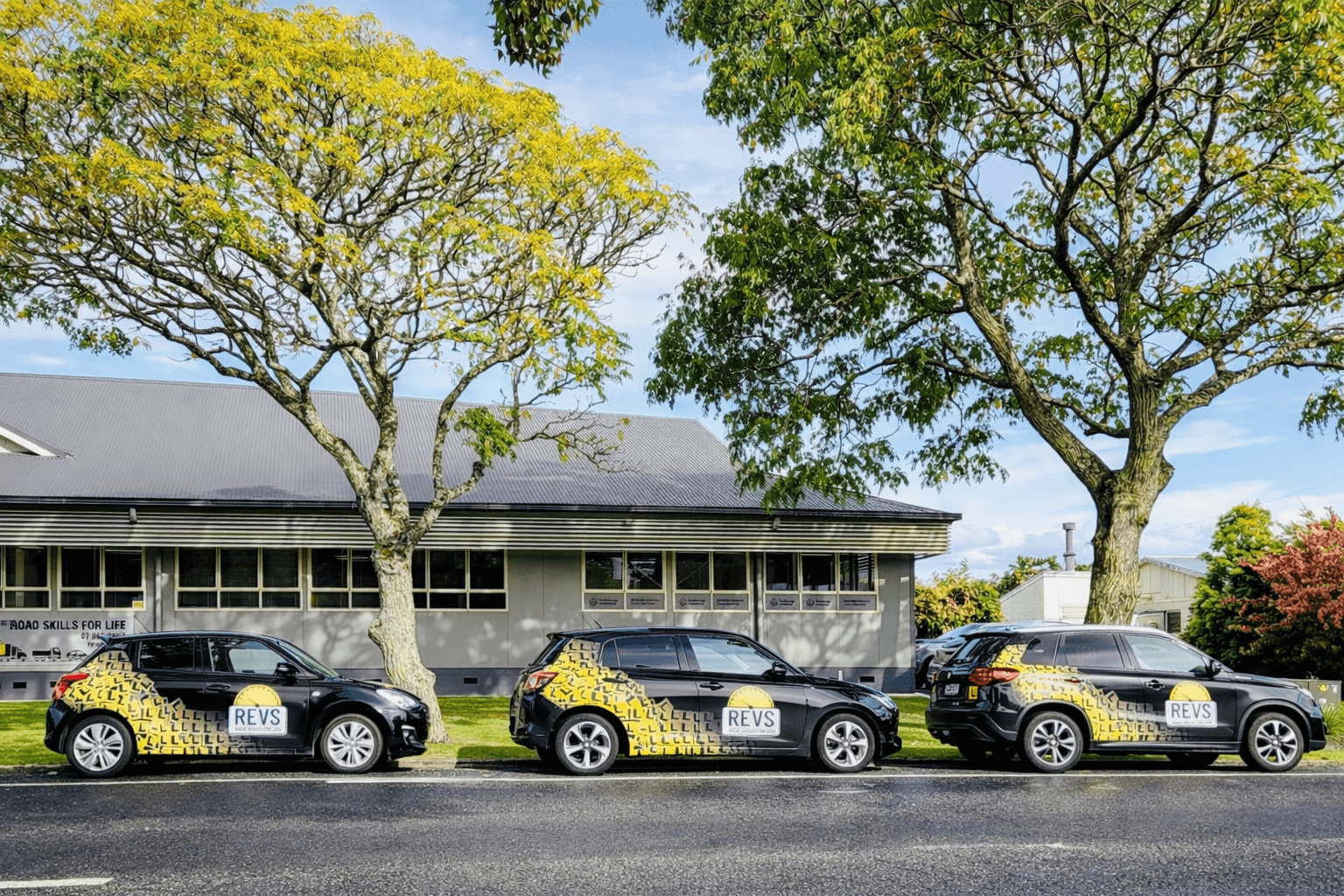
Most learners begin with us because they want a confident, structured introduction to NZ roads — whether they're a complete beginner, a recent migrant adjusting to driving on the left, or a returning driver who hasn't held a licence in years. Every Revs car lesson is one-on-one with a qualified instructor, run in a modern dual-control vehicle, and tailored to where you are in your driving journey rather than a one-size-fits-all syllabus.
We work across Thames, Paeroa, Kerepehi, Ngatea, Waihi, Waihi Beach and Rotorua, so we know the actual roads, intersections and routes used by NZTA testing officers in each location. By the time you sit your restricted or full test, you'll have practised on the very stretches of road where it counts.
The Graduated Driver Licensing System
Every car driver in New Zealand progresses through the same three licence stages. The rules are changing on 25 January 2027 — here's both the current system and what's replacing it.
Current rules — until 24 January 2027
The first step. You must be 16 or older and pass a 35-question theory test at an AA or VTNZ agency. Once you have your Learner Licence you can drive on the road, but only with a fully licensed supervisor (who has held their full licence for at least 2 years) next to you and "L" plates displayed.
After holding your Learner Licence for at least 6 months, you can sit your restricted practical test. You can then drive alone, but with conditions: no passengers (some exceptions), no driving between 10pm and 5am, and a zero alcohol limit if you are under 20 years old.
The final stage. You can sit your full licence test 18 months after getting your restricted or 6 months if you're over 25 years old. These times can be shortened to 12 months for under 25, or 3 months for over 25 if you complete an approved advanced driving course. Once you pass, all restrictions are lifted.
New rules — from 25 January 2027
No changes from the current rules. You must be 16 or older and pass the Class 1 Road Code theory test.
Minimum learner hold time changes: 12 months if under 25, 6 months if over 25. The hazard detection and hazard response element of the full licence test will be added to the new restricted practical test.
No practical test for full licence. Once you've held your restricted long enough, you upgrade straight to full.
Under the new system from 25 January 2027, any infringement notice issued to a restricted licence driver will increase the time to your full licence by 6 months. Every ticket you get with demerits adds another 6 months on top — and there is no method that allows you to recover that time.
How to pass first time
Most learners who fail their restricted or full test do so for the same handful of reasons. Here are the ones our instructors see most often, and how we coach you around them in the lead-up to your test.
Test officers fail learners who fix their eyes 10 metres in front of the bonnet. Lift your scan to the next intersection or 12 seconds ahead. Smoother steering and better hazard reactions follow automatically.
Every lane change, every turn, every roundabout. Officers want to see deliberate, visible head checks. We practise the sequence until it's automatic.
"Stop" means a full, complete stop with the car not moving — not a slow roll. It's one of the most common immediate fail items on restricted or full tests. We will show you techniques to help with this.
The posted speed is the maximum, not the target. In wet weather, school zones, suburban streets and tight corners, driving at or just under the posted limit shows the officer you're reading the road, not just obeying signs.
You can be asked to perform either at any point in stage 1 of the restricted practical test. We practise both on real residential streets — not empty car parks — so the test feels like just another practice run.
One small slip rarely fails a test. What does fail people is unravelling for the next ten minutes. We coach you on how to reset, breathe, and keep driving as if nothing happened.
We'll help you achieve your goals and stay safe on the road.